Coachlines - September 2026
24.09.26 Steward Mark Jurd
When did a Master Coachmaker last build and drive his own coach?
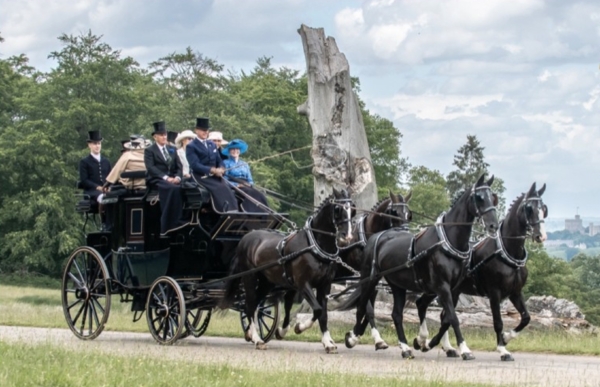
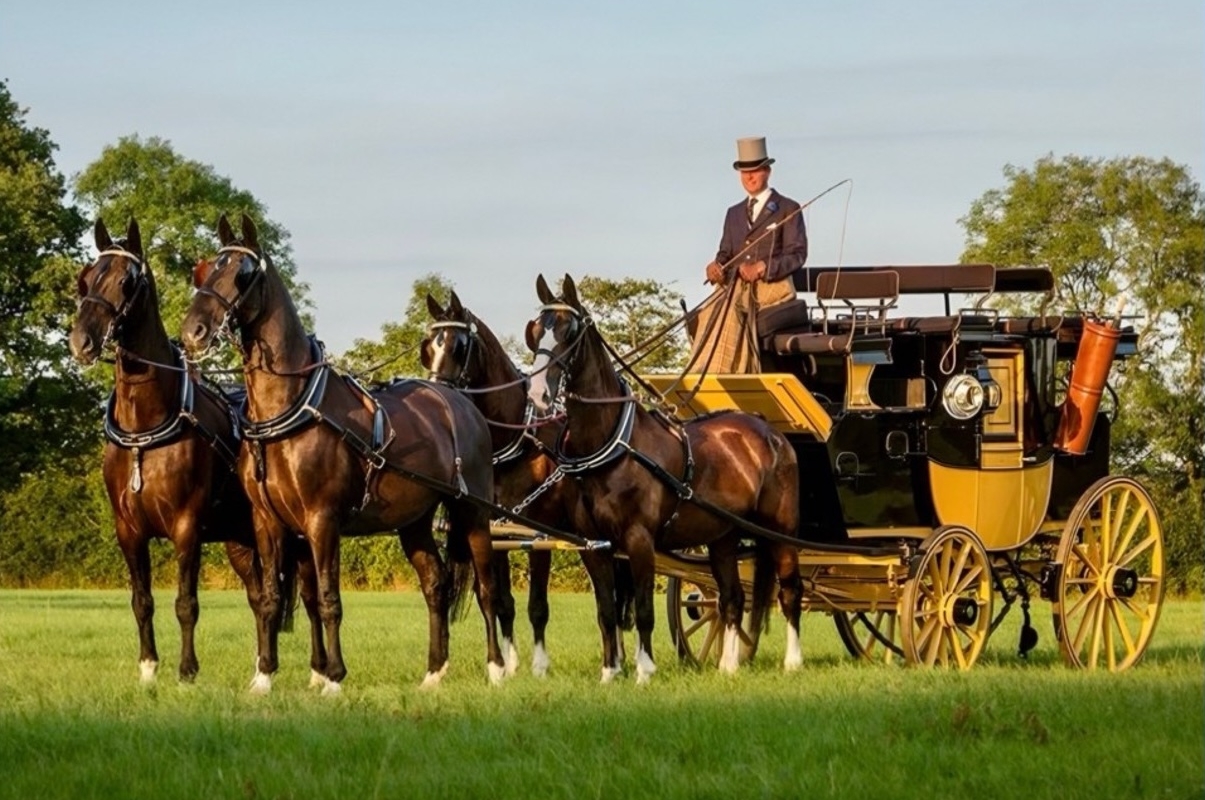
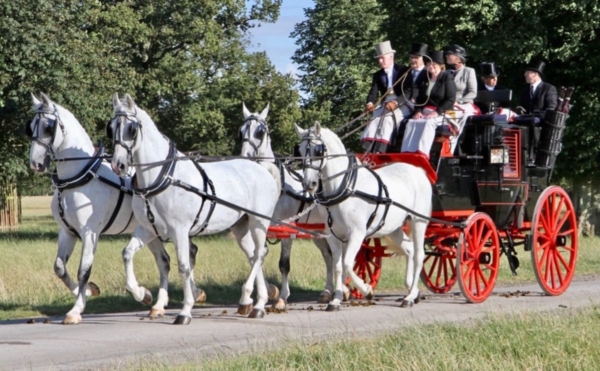
Pictured above: Mark Broadbent, Master Coachmaker and President of the Coaching Club with his team of Dutch warmbloods to a Private Drag by Holland & Holland of London (photograph courtesy of Jo Hansford).
As the Coachmakers begins the celebration of its 350th anniversary, it is particularly appropriate that our new Master should be a practising coachmaker and skilful carriage restorer. Additionally, Mark is a talented horseman and a highly accomplished team driver, with considerable experience in both the adrenaline-fuelled sport of horse driving trials and the more traditional world of private driving and coaching. The Coaching Club, of which he is also President, was founded in 1871 and is the world’s oldest surviving club of its kind.
After 155 successful years, the Coaching Club continues to hold its regular driving meets and as the bastion of four in hand driving, it faithfully maintains the coaching traditions for which Britain is so well known and respected by traditional driving enthusiasts all over the world.
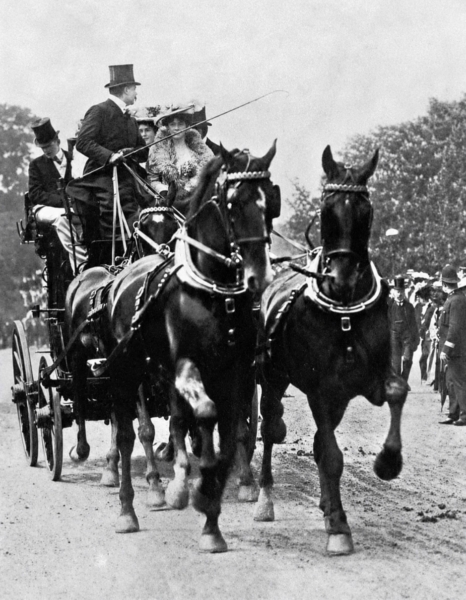 Pictured above: 1907, then President of The Coaching Club, Lord Desborough, leading the opening meet of the season in Hyde Park.
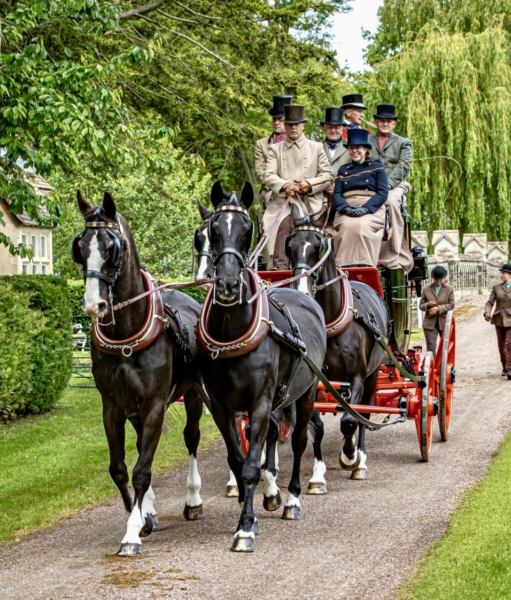 Pictured above: Master Coachmaker and Coaching Club President, Mark Broadbent tooling the ribbons of one of the few original mail coaches to have survived, The Quicksilver, famous for being one of the fastest coaches in the country. After hundreds of hours of research, this iconic coach was painstakingly restored by him for proud owner, Liveryman Portia Kenneway, seen sitting next to him on the box seat. The team secured first place in its class at this year’s Royal Windsor Horse Show and was placed Reserve Champion overall.
During a Coachmakers’ webinar earlier this year, while Senior Warden, Mark Broadbent posed the interesting question, “When did a Master Coachmaker last build and drive his own coach?”
Intrigued by the question, I turned to the Company’s detailed list of Past Masters. A number of names were immediately recognisable as representatives of some of this country’s finest coach building companies. Could it be that any of them were possessed of the same skill set as our new Master?
Richard Turrill was Master in 1836 and Thomas Peters followed 10 years later. The Peters connection with the Company was particularly remarkable, with four family members holding the Company’s most senior position between 1846 and 1863: John Winpenny Peters became Master in 1858, William Winpenny Peters in 1860 and Joseph Peters in 1862.
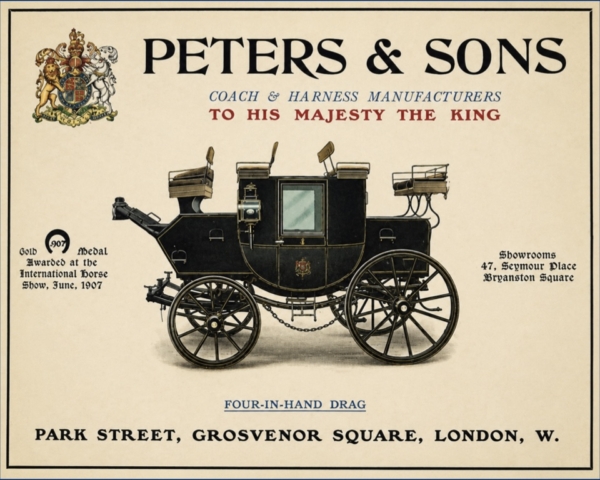 Pictured above: Peters & Sons was one of the most distinguished names in 19th century British coachbuilding. Established in 1798, the firm operated from Park Street, Grosvenor Square, at the heart of fashionable London, building carriages for British and foreign royalty. By 1879 the firm was listed among London’s leading coachbuilders alongside such celebrated firms as Barker, Hooper and Turrill.
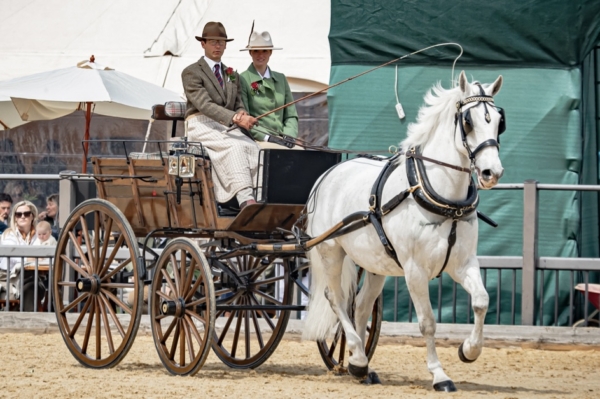 Pictured above: Royal Mews’ Coachman, Andrew Hogg taking part in Royal Windsor’s 2026 Concours d’Elegance with one of the royal household’s famous Windsor greys to a varnished Dogcart by Peters & Sons.
William Thomas Thorn followed in 1865, while the great Hooper coachbuilding dynasty was represented by George Norgate Hooper in 1874 and William Hooper in 1875. George Athelstane Thrupp, of Thrupp & Maberly, became Master in 1883.
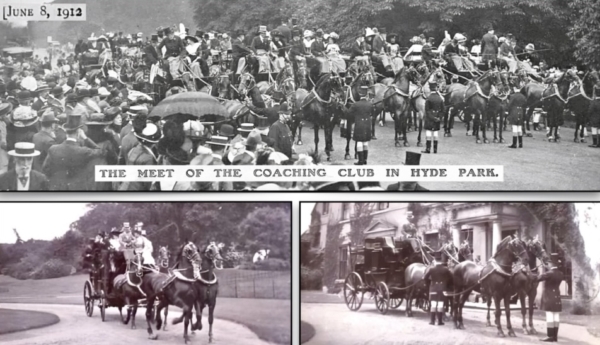 Pictured above: A Thrupp & Maberly Park Drag in 1912, owned and driven by Captain Quintin Dick. Image top shows the Coaching Club Meet in June of that year where the sporting Captain can just be seen in the grey top hat. Thrupp & Maberly belonged to the coachbuilding elite; holding a royal warrant as coachmaker to HM Queen Victoria, awarded in 1863. Past Master George Athelstane Thrupp wrote a number of important works, including, ‘A History of the Art of coachbuilding’ in 1877 and ‘Coach Trimming’, with William Farr, in 1888.
The tradition continued into the 20th century. John Philipson became Master in 1916 and William Lawton-Goodman, another name synonymous with British coachbuilding, served in 1930. (Both of these gentlemen have previously featured in the Influential Past Masters series in the October 2025 and July 2026 editions of Coachlines).
The Croall family, whose coachbuilding roots stretch back into the great Scottish coaching era have subsequently provided several Past Masters: Peter Croall in 1938, Peter Shaw Croall in 1962 and Robert Croall in 1997, who remains an active member of the Company today.
 Pictured above: Her late Majesty Queen Elizabeth’s retired Head Coachman Colin Henderson with his Private Drag by John Croall & Sons, driven to Freeman John Brown’s team of Dutch greys at the 2012 Coaching Club Meet at Badminton House, the country seat of the Coaching Club’s first President, Henry Charles Fitzroy Somerset, the 8th Duke of Beaufort, (1824-1899).
John Croall, founder of Scotland’s premier coach builder, was not only a uniquely talented coachmaker. In 1849, The Caledonian Mercury reported on the firm’s contract to supply the Tsar of Russia with 20 bespoke and extremely opulent coaches, remarking that Croall senior: ”Being an accomplished coachman himself, drove the first stage from Moscow to St Petersburg”.
Croall was not a Master of the Coachmakers, although later generations of his family were, but his story demonstrates that practical coachmanship and the coachbuilding trade were by no means mutually exclusive.
As these various images have shown, there can be little doubt that many Masters of the Company possessed an extraordinary practical knowledge of carriage construction. However, proving that they could also drive four horses is rather more difficult.
The absence of surviving evidence that a particular coachbuilder drove a team should certainly not be taken as evidence that he could not.
Indeed, it is difficult to imagine how one of the great coachbuilders of the 19th century could have practised his craft without an intimate understanding of the horse and the principles of draught. The accomplished coachbuilder therefore needed to understand considerably more than timber, ironwork, springs and paint. He needed to understand how the vehicles he designed and built would actually behave on the road.
It would perhaps be comparable with an accomplished motor manufacturer designing and building cars without ever having experienced one from behind the steering wheel.
That does not, of course, allow us to conclude that Richard Turrill, Thomas Peters, George Hooper or George Athelstane Thrupp could necessarily have taken a well-matched team through Hyde Park with the polish expected of the great amateur coachmen. It does, however, make it entirely reasonable to suppose that practical driving knowledge formed an essential part of the world in which these men worked.
The Coaching Club records
One obvious avenue of investigation is the Coaching Club.
Interestingly, none of the Past Masters identified above appear among the Club’s membership, nor do any other Past Masters listed in our records from the date of the Club’s inception in 1871. But that fact must be viewed in its historical context. The Coaching Club was very much a gentlemen’s driving club. Particularly during its first century, its membership was drawn predominantly from the aristocracy, landowning families and military officers. Professional coachmen were conspicuous by their absence and, however successful or respected, a man whose background lay in trade may have found admission considerably more difficult, if not in fact impossible.
The earlier and even more exclusive Four-in-Hand Club, of 1856, presents a similar problem. Its membership represented the highest levels of Victorian society. The coachbuilders and the gentleman coachmen inhabited closely connected worlds, but it was highly unlikely that they would be members of the same clubs.
Initial enquiries in various newspaper archives and other relevant literature has also proved fruitless. And so the original question remains tantalisingly unanswered. Somewhere in the Company’s long history there may yet be a Master who can be shown conclusively to have both built and driven his own coach. For the moment, however, the evidence does not allow us to name him with certainty.
What we can say is that the question has acquired particular relevance in 2026. On 1st September, Mark Broadbent became Master as the Company entered its 350th anniversa1y year. He is not merely someone with an appreciation of the coachmaking tradition: he is himself a highly experienced coachmaker and restorer, an accomplished four-in-hand driver and President of the Coaching Club.
Whether one of his predecessors combined those same skills remains a fascinating subject for further research. However, 190 years after the first person on our list, Richard Turrill became Master, we can say with certainty that our 350th anniversary year is most appropriately marked by having a genuine coachmaker and accomplished coachman as our Master Coachmaker.