Coachlines - October 2026
29.10.26 Steward Mark Jurd
Coachmakers help maintain heritage of road coaching
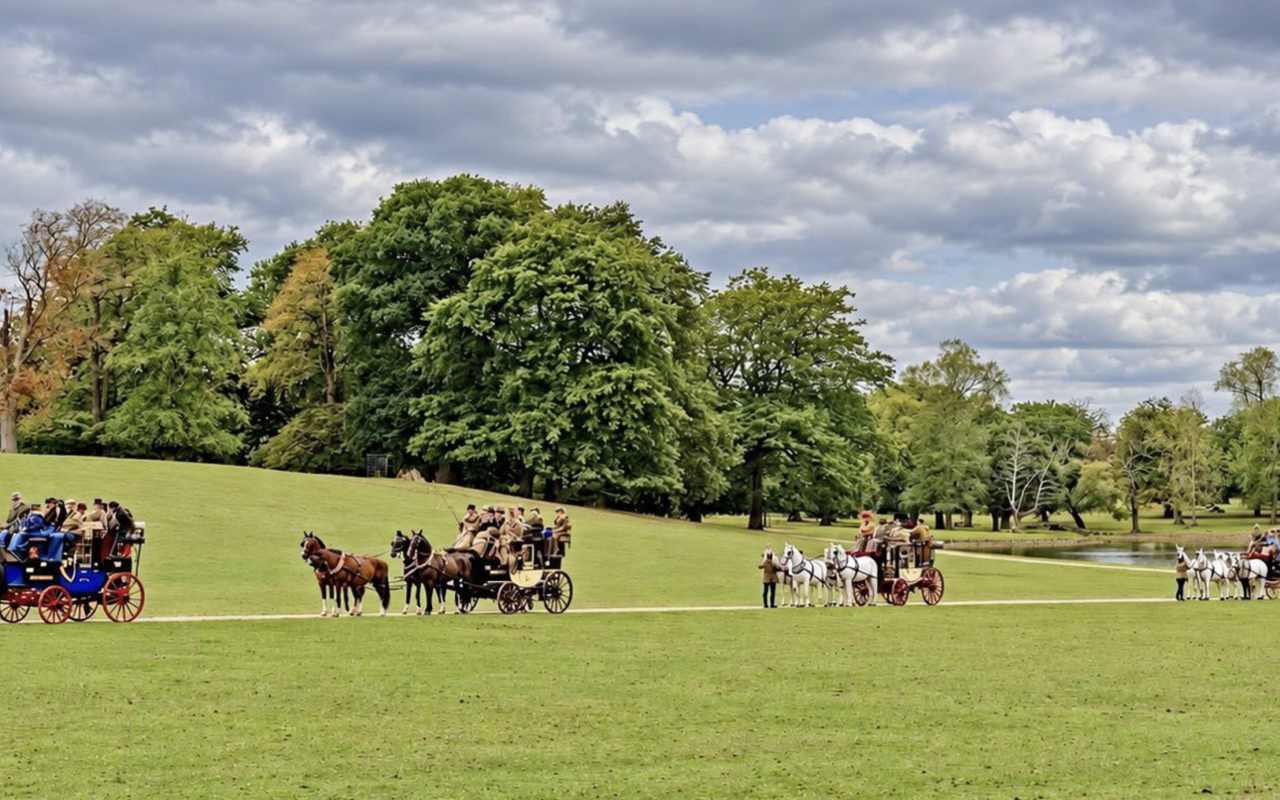
Pictured above: Five road coaches came together at Woburn Abbey for a memorable weekend celebrating the traditions of British road coaching.
Just as the 2026 driving season was drawing to a close, a group of coaching friends came together for a rather special coaching treat: five road coaches tooling the lanes in and around the glorious setting of Woburn Abbey during the first weekend in October.
Among those enjoying the occasion were three Liverymen of our Company – John Brown, William Malone and myself, all travelling aboard The Nimrod.
The unique estate of Woburn Abbey is home to the West family’s professional driving yard, Westways Carriage Horses. Their enthusiasm for all things driving, combined with the generous hospitality of the Duke and Duchess of Bedford, has seen Woburn Abbey become a much-favoured venue, with both the Coaching Club and the Road Club being regular visitors.
Woburn’s coaching heritage
Woburn’s association with coaching reaches back far beyond the present revival. Although the most direct road towards Manchester followed the old Roman road of Watling Street through Dunstable and Fenny Stratford, an important branch left the main road at Hockliffe and passed through Woburn, Woburn Sands, Wavendon and Newport Pagnell before continuing northwards.
Woburn consequently became an important staging and horse-changing town, serving not only the Manchester road but also coaches travelling to Leeds, Leicester, Derby, Halifax and Northampton. The Manchester Telegraph is recorded as passing through the town, while the Defiance called at the Goat Inn.
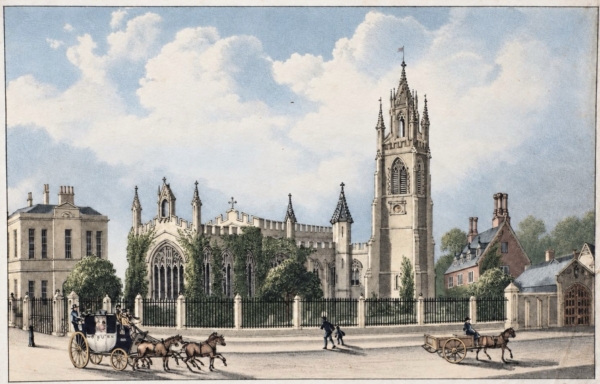
Pictured above: Woburn High Street in 1831, recalling the town’s importance during the great coaching era.
At the height of the coaching era, Woburn is said to have possessed as many as 27 inns. Among them were the Goat, the Magpie and the George, later renamed the Bedford Arms and today known as the Woburn Hotel.
Woburn Abbey occupies a unique place in English social history as the home of afternoon tea. In around 1840, Her Grace Anna Maria Russell, Duchess of Bedford, began taking tea with bread and butter and cakes during the long interval between luncheon and the increasingly late evening dinner. Soon, friends were invited to join her, transforming what was a private refreshment into a fashionable social occasion. This association has particular relevance to our Company, as we hope to celebrate the tradition of afternoon tea at Woburn Abbey as part of our 350th anniversary celebrations.
Five coaches on the road
For David and Emma West, driving horses is not just a job; it is their passion and way of life. Whilst most working people want to switch off at the weekend, they took what most would regard as a busman’s holiday and invited a group of friends to Woburn to join them for a weekend of coaching.
David and Emma’s association with our Company continues this November, when they will once again be horsing one of the Coachmakers’ coaches taking part in the Lord Mayor’s Show, with a magnificent team of black Friesian stallions.
The five coaches assembled for the occasion were The St David, The Monarch, The Regulator, The Tantivy and The Nimrod.
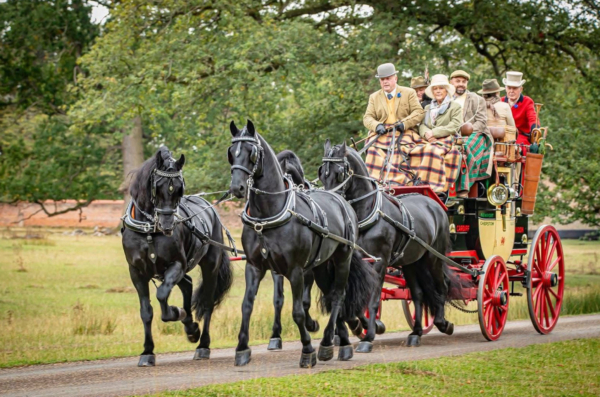 Pictured above: David West tooling the St. David with the family’s Friesian stallions
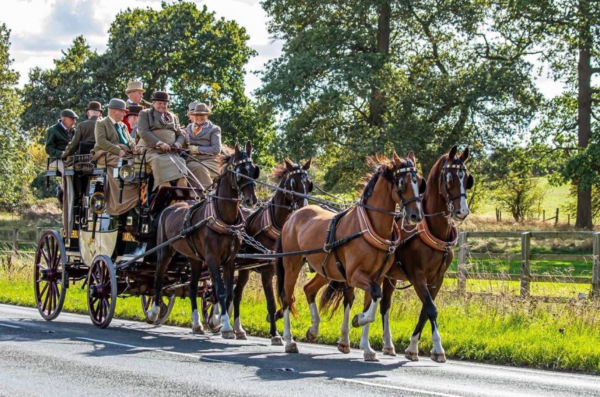 Pictured above: Coachman John Brown with fellow liverymen William Malone and Mark Jurd
We were blessed with glorious weather for the whole weekend and set off on Saturday’s drive around 11am. Unlike the stage coaches of the past, our itinerary was more of a relaxed affair, with the emphasis firmly on having as much fun on the road as possible. We left Potsgrove, trotted through Woburn village and on into the estate.
Despite being so close to one of England’s busiest highways, the M1, the surrounding area is quite lovely and we quickly felt a world away from six lanes of busy motorway. Woburn Abbey’s expansive deer park provided a magnificent setting for our five coaches. More than 1,100 deer from nine species roam freely around the park and seemed unperturbed by the sight of our teams trotting along the tracks between them. A couple of the larger herds were even brave enough to run between the coaches and, to our relief, the horses paid them no attention whatsoever.
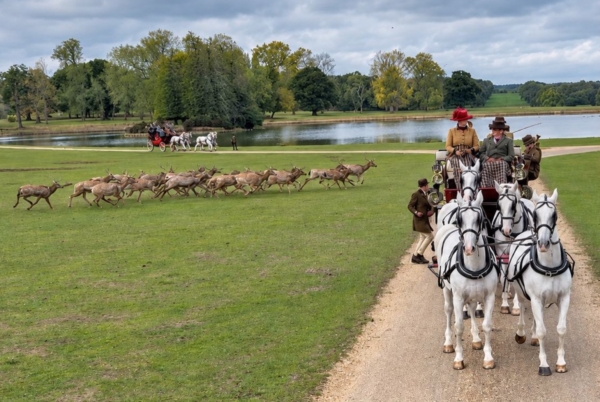
Our route took us through the surrounding countryside, stopping regularly at traditional inns for refreshments. Given that road coaches have always stopped at inns, we modern-day enthusiasts remain committed to maintaining a tradition upon which the success of the stage coach completely relied!
On Sunday, we stopped again at the picturesque Chambers Bridge, halfway round the estate, where we raised our glasses to propose the ubiquitous toast ‘to the road’, a tradition still observed by the Coaching Club, whose President is our own Master Coachmaker, Mark Broadbent. The Club was founded in 1871 and is the world’s oldest driving club.
The sight of five road coaches standing together was truly special, enough to quicken the pulse of this coaching enthusiast. This report can only go so far in its attempt to capture the flavour of this unique weekend. You, the reader, can only imagine the mellow sound of the coach horn, or the deep mournful call of the stags whose rutting season had just begun. Two stags fought as we passed, the air resounding as their horns slammed together. This is the stuff of which wonderful lasting memories are made.
The legacy of the road coach
The ability to tool a coach-and-four is regarded as the pinnacle of driving, and a gentleman’s turnout of a matched team to a park drag is held in the highest regard of all. In fact, a prerequisite of Coaching Club membership is the ownership of your own private coach and team. Road coaches can only participate at its meets by invitation, or at meets specially organised for that purpose.
However, the driving clubs, talented private coachmen and wonderful private coaches for which Britain is famous would never have evolved if it were not for the road coach and the gifted professionals who drove them. These were whips of the highest order, the likes of Charles Holmes, who drove the Oxford coach for 26 years without incident, clocking up nearly 500,000 miles, and Charles Ward, who started driving a night mail coach in Norfolk before he was 18. His long and illustrious career included tooling the “Quicksilver” Devonport mail coach for seven years, which was painstakingly restored and driven by our Master Mark Broadbent, for its proud owner, Portia Kennaway, a Freeman of our Company.
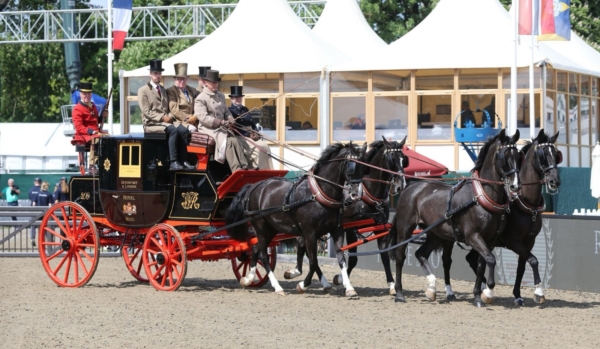 Pictured above: The Quicksilver restored and driven by Master Mark Broadbent with owner, Freeman Portia Kennaway on the box-seat alongside
The professionals taught the amateurs, allowing them to take the reins on the actual routes they drove, even though it was prohibited. These sporting Jehus paid handsomely for the privilege and from their ranks sprang the famous driving clubs, which became particularly relevant after the train ousted the stage coach from the road and played a significant role in the preservation of British coaching heritage.
As the Duke of Beaufort observed in Driving, published as part of the Badminton Library in 1889, the disappearance of working coaches meant that amateur driving was no longer influenced and inspired by the ‘real business’. The Duke makes the point that, while the working coaches still ran, amateur coachmen learned from – and were measured against – the real business of road coaching. A true coachman was not born from occasional display, but from constant practice with different horses, teams and vehicles, over every variety of road and in all conditions.
This is the enduring legacy of the road coach: it established the standards of horsemanship, road-craft, punctuality and coachmanship upon which the traditions we know and enjoy today were built.
It is no coincidence that a number of today’s private coachmen still celebrate the road coach. In fact, all the owners who took part at Woburn own their examples alongside the private coaches they also drive, enabling them to enjoy unique occasions such as this.
As we celebrate the 350th anniversary of our Royal Charter, granted by King Charles II in 1677, it is particularly appropriate that members of our Company should continue to play an active part in maintaining the traditions upon which our craft and heritage were founded. Good food, great company and a sporting adventure made possible by our noble friend the horse, the hospitality of the Duke and Duchess of Bedford, and the heritage of the road coach.