
Coachlines - October 2026
29.10.26 The Clerk Lt Col Craig Hallatt
Clerk’s Notes – October 2026
Jones and Othello: The horses who pulled the guns
As we are now fully ensconced in our 350th anniversary year I thought it worth mentioning a forthcoming partnership with The King’s Troop Royal Horse Artillery which is also approaching a particularly significant milestone, the 80th anniversary in 2027 of King George VI bestowing the name ‘The King’s Troop’.
This month’s Clerk’s notes seems an especially appropriate moment to look back at one of the most evocative stories within the long history of the Royal Horse Artillery: that of two remarkable gun horses, Jones and Othello.
The anniversary has a pleasing historical precision. The unit had been formed as the Riding Troop in 1946, but on 24th October 1947, King George VI altered the visitors’ book, striking out the word ‘Riding’ and inserting ‘King’s’. The name has endured ever since, and 24th October remains associated with Troop Day.
For me, this is not simply a piece of regimental history. It carries a strong personal resonance because of another great Royal Artillery institution and its centuries-old association with Woolwich.
I had the enormous privilege of being the last Director of Music of the Royal Artillery Band and Orchestra during its historic residence in Woolwich, leading the Band as that remarkable chapter drew to a close in 2014. The Band was formed in Germany in 1762 during the Seven Years’ War and returned with the Royal Artillery to its headquarters at Woolwich the following year. In February 2014, current and former members marked its departure with a final musical parade through Woolwich.
After more than two and a half centuries, the sound of the Royal Artillery Band, which had been woven into the military and civic life of Woolwich for generations, was leaving its historic home. It was both a privilege and a poignant responsibility to lead the Band during that period.
So there is something rather satisfying about returning to Woolwich for this story.
Today, the Royal Artillery Barracks at Woolwich is home to The King’s Troop Royal Horse Artillery, whose horses, riders, drivers, guns and harness preserve one of the most magnificent living links with the traditions of the royal regiment. Its modern ceremonial duties include firing royal salutes to mark great occasions of state.
Yet behind that immaculate ceremonial spectacle lies a very different world, one in which horses were not present for ceremonial effect but were vital instruments of war.
And among them were Jones and Othello. The British Army records them as Royal Horse Artillery gun-team horses who served together throughout the First World War.
The Royal Horse Artillery was formed in 1793 to provide mobile artillery support to cavalry. Its defining characteristic was mobility. Horses enabled its guns, ammunition and men to move rapidly across the battlefield and bring firepower to where it was most urgently required.
By the time Jones and Othello went to war in 1914, that partnership between gunner and horse had already existed for more than a century. The First World War is usually remembered as an industrial conflict. It conjures images of machine guns, barbed wire, enormous artillery pieces and, eventually, tanks. Yet alongside these new technologies was a vast army of horses.
At the outbreak of war, an RHA battery equipped with six 13-pounder field guns comprised around 200 men and 228 horses. The horse was therefore no picturesque survivor from an earlier age. It remained fundamental to the Army’s ability to operate.
This was the world of Jones and Othello.
Partners in harness
Jones and Othello served as gun-team horses, with Jones also remembered as a lead horse. One surviving modern account identifies Jones as having served between 1914 and 1919 and describes him as a lead horse in the Royal Horse Artillery. Interestingly, it describes Jones as bay, rather than black, an example of how details within stories that have been retold over generations can sometimes differ from the surviving record.
What is firmly established in the British Army’s own account is their remarkable partnership: Jones and Othello served together throughout the First World War.
Four years during which warfare changed dramatically. Four years of movement, noise, danger and uncertainty, in which horse and man depended upon one another.
A gun horse required endurance, responsiveness and trust. Artillery horses worked as part of a team, responding to their drivers and helping move the guns wherever the battery was ordered to go. For the men of the Horse Artillery, caring for and understanding their horses was consequently not simply a matter of affection. Their effectiveness depended upon them.
Jones and Othello were just two individuals within an enormous animal army.
Research into Britain’s military use of horses records that the British Army possessed around 25,000 horses on the eve of the Great War. By the middle of 1917, it had approximately 591,000 horses, alongside 213,000 mules, 47,000 camels and 11,000 oxen.
Animals were essential to transportation, reconnaissance and the movement of artillery and supplies. The ability to mobilise them on such a huge scale was fundamental to the British war effort.
Every horse had its own temperament. Each had to be fed and watered. Hooves required attention, harness had to be maintained, and sick or wounded animals needed veterinary treatment. The British military invested enormously in purchasing, training and transporting horses and mules to where they were required.
For the soldiers who worked with them, these were not merely anonymous pieces of military equipment. They were individual animals with whom men spent countless hours.
There is something particularly moving about the courage of the military horse.
A horse could have no understanding of national strategy, military objectives or the reasons why armies went to war. It could not comprehend why shells were exploding or why it was being asked to move towards danger.
Yet the horses continued to work alongside their human companions.
Jones and Othello’s achievement therefore lies partly in that simple statement that they served together throughout the conflict. Survival through those years was itself remarkable.
The experiences of other RHA horses help illustrate the conditions through which military horses could pass. Historical research records seven horses of F Battery, RHA, that went to France in August 1914 and served through campaigns including the retreat from Mons, First and Second Ypres, Festubert, Aubers Ridge, Vimy Ridge, the Somme, Hill 70 and Cambrai. Those horses eventually returned to England.
We should not attribute that precise service record to Jones and Othello without documentary evidence, but it provides a vivid impression of the extraordinary world in which RHA horses could serve.
Horse and gunner
The relationship between a Horse Artillery soldier and his horse extended far beyond riding or driving. The effectiveness of Horse Artillery depended upon teamwork between horses, drivers and gunners. Long movements, bad weather, fatigue and danger were shared experiences. Drivers came to understand the character of individual horses, while the animals themselves became accustomed to familiar voices and hands.
It was a partnership born of necessity, but one that inevitably developed a profound human dimension. That distinctive relationship between horse and gunner remains visible today.
The King’s Troop Royal Horse Artillery is His Majesty’s Mounted Ceremonial Battery. Mounted gunners and gun-team drivers continue the traditions of riding and driving, supported by specialist skills including those of farriers and saddlers.
Watch a modern gun team moving at speed and there is therefore something much deeper taking place than spectacle.
Today’s polished harness, beautifully turned-out horses and historic guns connect us with generations who practised the same skills when they were requirements of warfare rather than ceremonial tradition.
And within the army’s account of that heritage, two horses are still remembered by name: Jones and Othello.
The King’s Troop Royal Horse Artillery: From battlefield necessity to national ceremony
After the Second World War, and following the mechanisation of horse-drawn artillery, King George VI wished to retain a troop of Horse Artillery to take part in the great ceremonies of state.
The Riding Troop was reformed in 1946, and in 1947 the King created the name that survives today: The King’s Troop Royal Horse Artillery.
The modern Troop therefore connects two very different worlds. One is the magnificent spectacle of ceremonial Britain: horses and guns appearing at some of the most important moments in our national life. The other belongs to Jones and Othello: a harsher world in which horsemanship, harness, teamwork and the ability to move a gun were operational necessities.
That is why their story matters.
Their importance is not that they fought independently of their human companions. Quite the opposite. They represent the extraordinary partnership between soldiers and animals upon which an army still depended during the First World War.
More than a century later, Jones and Othello have come to represent something larger than themselves: the contribution of countless working horses whose strength and endurance supported the British Army through the Great War.
A living tradition
The story of Jones and Othello is not simply a tale from the past. Their legacy can still be seen in the horses, horsemanship and guns of The King’s Troop Royal Horse Artillery, preserving a tradition that once carried artillery into battle and today forms part of Britain’s great ceremonial life.
For the Coachmakers, that connection has recently become even more tangible. The Worshipful Company of Coachmakers and Coach Harness Makers has donated £1,000 towards the production of a bronze sculpture of Jones and Othello, commissioned by The King’s Troop.
It is a contribution of which we can be particularly proud. What better way to commemorate these two remarkable horses than through a lasting work of art that will help ensure their story, and through them the contribution of so many military horses, continues to be told to future generations?
The sculpture also seems especially appropriate as The King’s Troop Royal Horse Artillery approaches the 80th anniversary of its naming in 2027, recalling that moment in October 1947 when King George VI replaced “Riding” with “King’s”.
There is another happy connection ahead.
During the Coachmakers’ own 350th anniversary year, The King’s Troop will be one of our partners at the Royal Windsor Horse Show in May 2027, bringing together organisations whose histories are so closely associated with the horse, harness, craftsmanship, transport and service.
For me personally, there is a pleasing symmetry to it all: from my own Royal Artillery connection and the departure of the Royal Artillery Band and Orchestra from Woolwich in 2014, to the story of Jones and Othello, and now to the Coachmakers supporting their permanent commemoration and sharing a platform with The King’s Troop at Windsor.
Coachmaker tickets for our day at the Royal Windsor Horse Show on Friday 14th May 2027 will go on sale shortly, and I hope that as many members of the Company as possible will join us.
It promises to be an occasion on which we can celebrate not only 350 years of the Coachmakers, but also the enduring relationship between horse, harness, carriage and gun. It will be a chance to look back with pride at the skills and traditions that shaped our respective histories, while demonstrating that this extraordinary heritage remains relevant, vibrant and very much alive.
And somewhere at the heart of that story remain two faithful gun horses, Jones and Othello. Partners in harness, veterans of the Great War and now the subjects of a new bronze sculpture, their names have survived when those of countless other working horses have been lost to history.
Company events
The Aerospace Awards Dinner is now sold out. We do have an active waiting list for those who wish to take their chance on a place becoming available, please contact the Clerk to register for this list.
The Coachmakers’ Family Christmas Carol Service 2026
Thursday 10th December 2026
6.30pm-9.00pm
St James Garlickhythe, Garlick Hill, London EC4V 2AF
Our 350th Anniversary Coachmakers’ Christmas Carol Service is a fabulous opportunity to bring your family, friends, children and grandchildren to a magical celebration in one of the City’s most charming churches. St James Garlickhythe will be glowing with festive lights, warm music and the unmistakable spirit of Christmas.
A carol service for all ages
This year’s service is designed with families in mind – traditional carols, joyful music, and moments that little ones can enjoy just as much as the grown ups. The Coachmakers will cover the cost of the church and all musicians, helping keep the evening affordable for families.
Festive fork buffet by Cook & Butler
After the service, we will gather for a Christmas-themed fork buffet prepared by Cook & Butler, Guildhall’s renowned caterer. Expect delicious seasonal dishes perfect for adults and children alike – warm, comforting and full of Christmas cheer.
Tickets: £75 (Adults); £25 (Aged 16-18); Under-16s do not need a ticket.
Dress: Christmas smart casual
Families are warmly encouraged to attend – the evening is designed to be welcoming, relaxed and family friendly.
Your ticket includes:
Full admission to the Carol Service
Christmas fork buffet
Wine, soft drinks and refreshments
All musical entertainment (subsidised by the Company)
Venue hire (covered by the Coachmakers)
A Christmas evening to remember
This is the perfect way to begin the festive season – singing together, sharing food, and enjoying the company of fellow Coachmakers in a beautiful historic church. Whether it’s your first Coachmakers’ Christmas or a long standing tradition, we’d love to welcome you – and your whole family – to this special celebration.
Book early – family events fill quickly. We look forward to celebrating Christmas with you.
Celebrate 350 years of the Coachmakers with our limited edition silk tie & scarf
To mark our 350th anniversary, we have a pair of exclusive commemorative items – crafted with the same pride in British workmanship that has defined our Company since 1677.
Introducing our 350th Anniversary Tie and Scarf, each beautifully made in the UK from 100% pure silk and designed in the Company colours. Both feature a specially commissioned 350th Anniversary Coat of Arms and a weft-weave carriage – subtle yet impressive – and created to honour this remarkable milestone in our history.
 The Anniversary Tie – £25
A classic, elegant silk tie suitable for all formal and Livery occasions. Its refined design and anniversary crest make it a perfect keepsake for members, friends, and supporters of the Company.
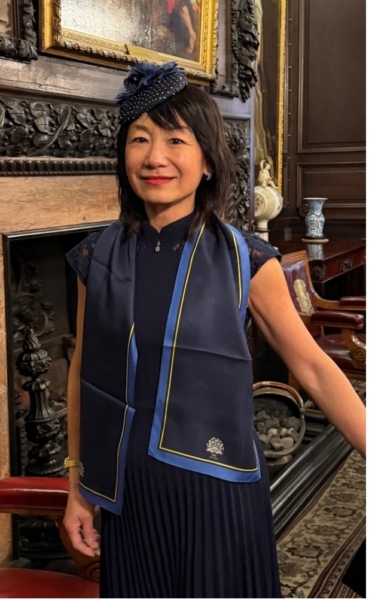 The Anniversary Scarf – £30
For the ladies this light, luxurious, and beautifully finished, the silk scarf offers a stylish way to celebrate our heritage. Ideal for wearing at Company events or gifting to those who share our pride in the Coachmakers’ story.
These limited edition items are available while stocks last. Whether worn with pride or treasured as a piece of Livery history, they are a fitting tribute to 350 years of craftsmanship, mobility, and service.
Join us in celebrating this landmark year for the Coachmakers and secure yours today by visiting the shop page on the Coachmakers’ website.